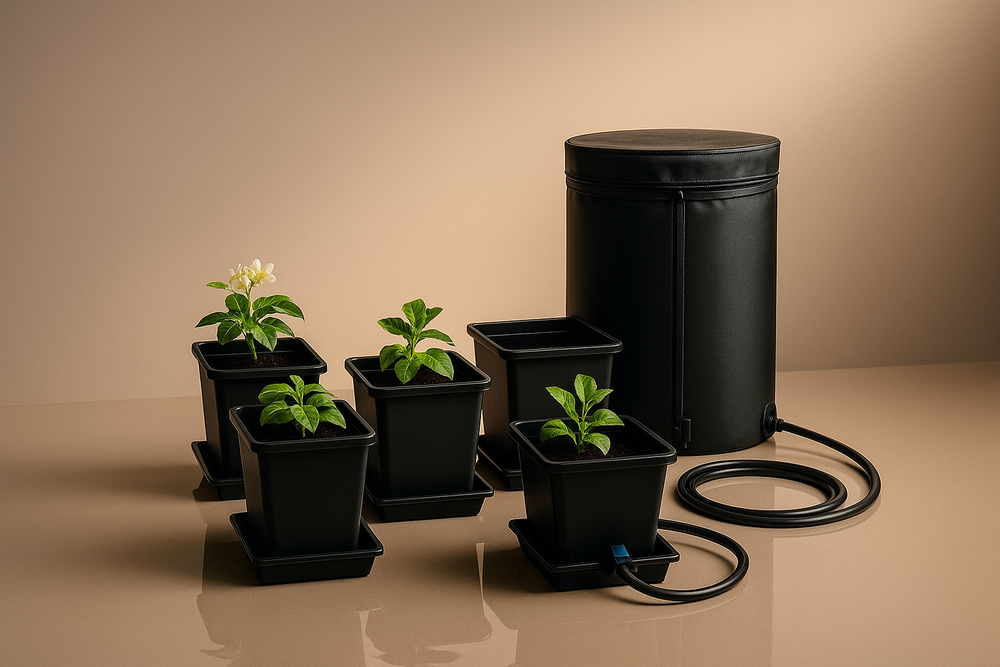


4-Pot vs 8-Pot Starter Kits: Which to Choose
Choosing between a 4-pot and an 8-pot hydroponic starter kit isn’t about pot count, it’s about space, workload, and harvest goals. This guide breaks down tent size, maintenance, and upgrade paths so you can pick the setup that fits your grow style without overbuilding.
Both 4-pot and 8-pot starter kits can grow great crops. The real question is how much space, time, and harvest you actually want to manage. This guide walks you through footprint, workload, and upgrade paths so you can choose the kit that feels “easy mode” instead of overwhelming.


Step 1 Start from space and harvest, not pot count
Pot count is just a shortcut for how much canopy you’re committing to. Before you pick a kit, decide:
- How much floor space you can give the system (2×2, 2×4, 3×3 tent, open rack, etc.).
- Whether you want steady salad/herb supply or heavier harvests of fruiting crops.
- How often you want to mix nutrients and check and .
| 4-Pot Kit | 8-Pot Kit | |
|---|---|---|
| Typical footprint | 2×2 or half of a 2×4 | Full 2×4 or dense 3×3 |
| Reservoir size | ~15–25 L (4–6 gal) | ~35–60 L (9–16 gal) |
| Weekly workload | Light: 1 top-up + 1 quick check | Moderate: top-ups + more pruning and training |
| Best use | Salads, herbs, test runs, “learn the system” | Full household supply, mixed crops, small sales |
Step 2 When a 4-pot kit is the better choice
Choose a 4-pot kit if you want a system that is hard to overload and easy to learn on.
Best for beginners
- Fits cleanly in a 2×2 tent or corner of a 2×4.
- Reservoir stays stable longer, even if your and temps aren’t perfect yet.
- Less pruning and trellising; you can give each plant more space.
Ideal crops: lettuce mixes, basil, cilantro, chives, compact peppers.
Low-maintenance option
- Fewer pots means fewer chances for a single plant to dominate the system.
- Easier to keep even light and across all plants.
- Good match for 100–200 W LEDs at modest dimmer settings.
If you travel a lot or only want to mix nutrients once a week, start here.
Step 3 When an 8-pot kit pays off
An 8-pot kit makes sense when you already know you’ll use the extra canopy and you’re comfortable checking the system a bit more often.
- You’re running a full 2×4 or 3×3 footprint with a 250–320 W (or higher) LED.
- You want rotational harvests: half the pots in early growth, half closer to harvest.
- You’re okay logging readings a couple more times per week and trimming plants before they crowd each other.

Step 4 Match pots to light, valves and reservoir
Once you know your pot count, it’s easy to back into the rest of the system:
- Lighting: 4 pots pair well with a 100–200 W LED in a small tent; 8 pots usually want a 200–320 W panel with good edge coverage.
- Valves: plan one per pot for even moisture.
- Reservoir: aim for at least 1 gal (4 L) per pot, more if your room runs warm or dry.
Step 5 Upgrade path: start small, expand cleanly
You don’t have to pick the “forever” kit on day one. A clean upgrade path looks like this:
- Start with a 4-pot kit in a 2×2 or 2×4 and learn your environment.
- Dial in light height, dimmer and nutrient strength until new growth is consistently healthy.
- Add a second 4-pot tray or upgrade to an 8-pot on the same reservoir once you’re comfortable with mixing and logging.
That way your first kit keeps working as a dedicated salad or herb system, instead of becoming “spare parts.”
Not sure if 4 pots are enough—or 8 pots are too many?
Share your tent size, LED model and what you want to harvest each week. We’ll recommend a 4-pot or 8-pot layout, reservoir size and valve count so you don’t overbuild or underbuild.
Frequently asked questions
Is a 4-pot kit enough for one or two people?
For salads and herbs, yes. A 4-pot kit in a 2×2 footprint can keep one to two people in steady greens if you stagger planting and harvest. For heavy feeders like large peppers or tomatoes, think of a 4-pot kit as a test bed rather than your final system.
Will an 8-pot kit be too much for a beginner?
An 8-pot kit is still manageable, but you’ll be logging EC, pH and plant training a bit more often. If you’re brand new to hydroponics or short on time, starting with 4 pots and expanding once you’re comfortable is usually less stressful.
How big should my reservoir be for 4 vs 8 pots?
Use at least 1 gallon (4 L) of nutrient solution per pot as a baseline. For 4 pots, that usually means a 4–6 gallon reservoir; for 8 pots, 9–16 gallons keeps EC and pH more stable between top-ups.
What LED wattage should I pair with 4 vs 8 pots?
Most 4-pot setups in a 2×2 tent work well with a 100–200 W full-spectrum LED. An 8-pot kit in a 2×4 or dense 3×3 typically wants 200–320 W with good edge coverage so the outside pots don’t get starved for light.
Can I upgrade from 4 pots to 8 without replacing everything?
Yes. If you plan ahead, you can choose a reservoir and LED big enough for 8 pots, start with a 4-pot tray, then either add a second 4-pot tray or switch to an 8-pot tray later while keeping the same main hardware.
Are on-demand valves worth it compared to a small pump and timer?
For starter kits, gravity-fed on-demand valves are a nice quality-of-life upgrade. They remove the need for a timer, reduce the chance of overwatering, and let each pot drink at its own pace, which is forgiving when your environment isn’t perfectly dialed in yet.
Further reading
- Hydroponics: Choosing the Right Equipment
- No-Pump Irrigation: On-Demand Valves
- Tent Size to LED Wattage: A Quick Match Table
EC (Electrical Conductivity)
A fast way to estimate how strong your nutrient solution is. Higher EC = more dissolved fertilizer.
pH
Controls how available different nutrients are to plant roots. Most hydroponic crops prefer roughly 5.5–6.2.
VPD (Vapor Pressure Deficit)
How “thirsty” the air is. VPD ties temperature and humidity together and drives how hard plants transpire.
PPFD
The amount of usable light (photons) that actually hits the canopy, measured in µmol/m²/s.
On-Demand Valve
A gravity-fed valve that opens as the medium dries and closes when it’s saturated—no pump or timer needed.