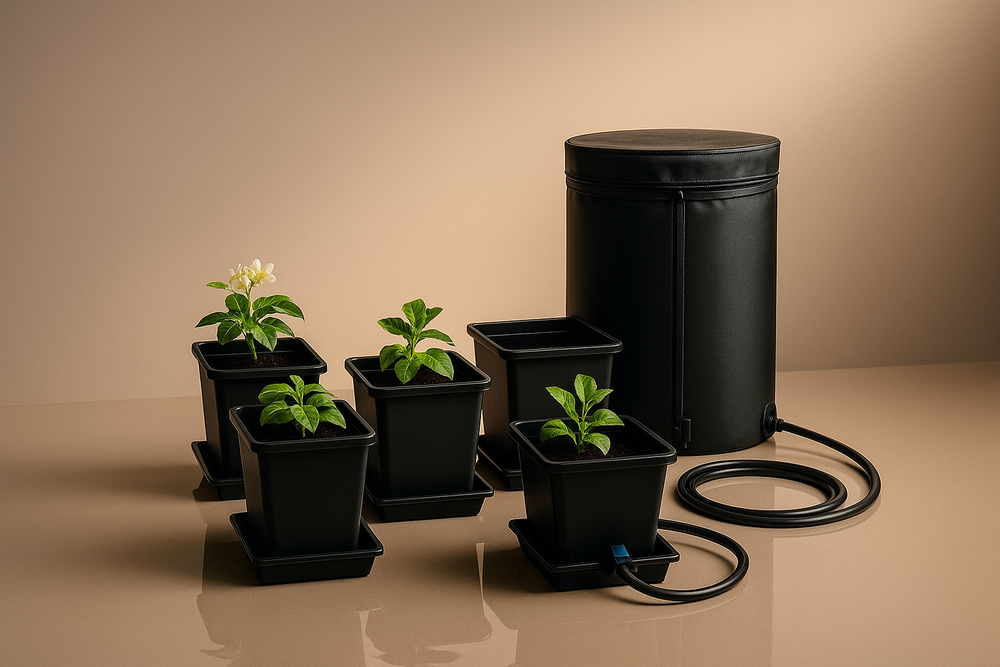


No-Pump Irrigation: How On-Demand Valves Work
Learn how gravity-fed on-demand valves let your hydroponic systems water themselves with no pumps or timers, just a raised reservoir, drip lines, and simple maintenance for consistent, quiet irrigation.

No‑pump irrigation explained
Most hydroponic systems rely on electric pumps that run on timers. There is a simpler option. With on‑demand valves and a raised reservoir, your plants can water themselves automatically, quietly and with zero energy use.
The principle of gravity flow
Water height creates pressure. Each meter of elevation adds about 1.4 . That gentle pressure is enough to push nutrient solution through tubing and feed valves without motors.
PSI
PSI means pounds per square inch. It measures water pressure. Even 1 to 3 PSI is enough for low‑flow hydroponic lines.
Inside an on‑demand valve
The system uses a small diaphragm valve that reacts to pressure changes. When media is saturated, internal pressure keeps the valve closed. As plants draw moisture, pressure drops and the valve opens. Flow resumes until balance returns, then the valve closes again.


Where no‑pump irrigation fits
- systems for steady nutrient films without timers.
- setups for quiet top‑offs that do not overflow.
- Drip or bag culture: low‑runoff and uniform moisture in media beds.
NFT
Nutrient Film Technique is a method where a thin stream of nutrient solution flows continuously along the root zone.
DWC
Deep Water Culture keeps plant roots suspended in aerated nutrient solution, often in raft or bucket systems.

Best practices for smooth flow
- Keep the reservoir 0.5 to 2 meters above crop level for gentle pressure.
- Use 100 to 200 mesh filters to prevent small clogs.
- Shade the reservoir or use opaque lids to block algae.
- Flush tubing monthly to keep flow balanced.
- Check and once or twice a week.
EC
Electrical conductivity indicates dissolved nutrient level so you can track feeding strength.
pH
Measures acidity or basicity. Most crops prefer 5.5 to 6.5 for optimal nutrient uptake.
Why growers choose gravity systems
- Energy‑free: Runs anywhere with a raised tank.
- Quiet and reliable: No hum and fewer moving parts to fail.
- Consistent moisture: Roots avoid flood‑and‑dry cycles.
- Modular: Add or remove zones without adding pumps.
Build your gravity system today
Create a no‑pump irrigation setup for any grow size. Explore valves, header tanks and tubing kits built for steady and efficient water flow.
Frequently asked questions
How high should my reservoir be?
Can I use this system with nutrient solution?
Do I need pumps for aeration?
Further reading
- Hydroponics: Choosing the Right Equipment
- pH & EC Meters: Setup, Calibration, and Care
- 4‑Pot vs 8‑Pot Starter Kits: Which to Choose
Next step: Visit Irrigation Controls to size your valves and header tanks for any setup.